|
There are exceptions, but the predominant flavors in Korea are hot and
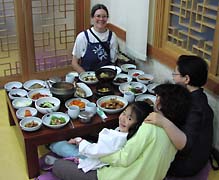
hellishly hot. Let's not forget garlicy and fishy. Yes, it's Asian, but Korean food is the total opposite of Japanese fare. In Japan the flavors are delicate and the portions dainty. In Korea flavors are strong and bold, and the portions immense (by world standards). The idea that a guest is meant to be stuffed to the gills is embedded in the culture, maybe because Koreans went hungry for so many years during and after the Korean war. The standard Korean greeting translates as "Have you eaten rice today?" Koreans, who allegedly don't perspire much, believe that the way to stay cool in their muggy summers is to work up a sweat. Therefore, if you're not sweating yet, the answer is to dump on more red pepper until you are. It's wintertime? That's OK, pepper will make you feel warmer, too. A typical Korean household will use something over a hundred red peppers in a year. So if you can't handle the hot stuff, you're going to need some guidance from your Korean friends or a savvy westerner at first. They'll help you learn which dishes you can take, and negotiate special treatment from the waiters. Of course, if you already like it hot, Korea is the place to be! When your mouth is on fire, you don't want liquid. That just makes it worse. Trust me, I know. You want something bland and starchy. Fortunately, Korean meals always include steamed rice. Usually there's also a main dish and several side dishes (panchon).
South Korea is on a peninsula and is about the size of Indiana, so no Korean city is very far from the ocean. Thus, you can't escape fish. Even if it's not the main dish, it will surprise you by appearing in side dishes and snacks. Who knows, you may even learn to love dried squid (chewy) and dried anchovies (nothing like the salty tinned ones Americans put on pizza, and a bit unnerving when they look at you with those blank little eyes). Beef, pork and chicken are common too these days. Korean meat consumption has soared in recent years, and their kids are taller for it. But Koreans still eat more noodles and rice, and less meat, than most Americans. They waste no part of the animal. Stuff that we put in our dog food, they put on the table. You can expect to find before you chicken feet, or an entire fish, complete with head, which any Korean will tell you is the best part. The side dishes usually include various vegetables and seafoods, often with soybean or sesame oil based sauces. Sides always include at least one type of kimchi. This is peppery, sour pickled cabbage and sometimes other vegetables, put by in truly impressive quantities -- the crocks are half to three-quarters of the height of a person -- every year at kimjang (kimchi time), after the cabbage harvest. The tartness comes from fermentation. Kimchi is made with lots of salt and red pepper, garlic, and usually some kind of fish or fish sauce. It's been called Korea's sauerkraut, but doesn't taste anything like it. Koreans credit kimchi for their good health. Back when bird flu was an issue, they said they weren't worried because their kimchi would protect them! Koreans swear it's addictive. Maybe to Koreans. We like it pretty well, but we haven't had any nicotine-like cravings or withdrawal symptoms. Give it a chance or two, though. You might learn to like it. If you're a vegetarian, I hope you're not too strict about it. Lots of Korean dishes look meatless, but sauces and flavorings tend to have meat or fish as an ingredient. Vegans have a tough time in Korea. Even kimchi is usually made with fish sauce or shrimp.At least in big cities, the situation is gradually improving. Seoul now has a growing list of vegetarian restaurants. Probably the best known (and maybe the oldest) is Sanchon, in the artsy Insadong neighborhood. It's run by a former Buddhist monk and specializes in fare inspired by Buddhist temple food (Buddhist monks don't eat animals). It has a set menu that varies by day. The servers bring you a bowl of beans and rice, then literally fill the table with panchon (side dishes). None of these is as bland as most temple food. In fact the flavors are surprisingly varied and subtle. Most evenings Sanchon provides some kind of Korean traditional dance and/or music for entertainment. This makes it a good place to take friends and family when they come to visit, but it helps if you're feeling wealthy. When we visited in 2006, the set menu was 35,000 Won per person, easily double the highest price we'd previously paid for a Korean meal. If Sanchon's menu doesn't have big enough numbers to impress your vegan guests, try Balwoo Gongyang. It's on the 5th floor of the Templestay building, right across the street from Jogye-sa, Korea's biggest temple. I don't know whether Balwoo (also Anglicized as Baru) Gongyang has world class food, but the prices sure imply that they think it does. We passed. For a much more modest meal, Jogye-sa itself has its own temple food kitchen. They built it on the ground floor of what used to be the Sam-O motel, our favorite place to stay in Seoul before Jogye-sa snarfed it up for their expansion. Four thousand won, a bargain in Seoul these days, buys you a simple monk's meal. The Jogye-sa Kitchen is open every day, 8am to 8pm. To get there, stand on the sidewalk facing the main temple gate, then turn and walk left. Turn right into the first little alley you come to, and that will take you there. Look for it on your right. It has an English sign above the entrance. You can also walk through the main temple gate, cut across the temple yard toward the left, pass the gift shop, and approach it from behind. The building looks like this from the rear. We tried to check out the Jogye-sa Kitchen when we were in Seoul in 2014. We found out that they couldn't take cash; we'd have to go back over to the temple gift shop and buy our meal tickets there. We decided we'd try it some other time. Alas, some other time never arrived that trip. Maybe next one. For something nicer than Jogye-sa's kitchen but more modest and casual than Balwoo and Sanchon, wander on over to the foreigner's neighborhood, Itaewon, and check out PLANT. Their bakery also does gluten-free goodies. Cosmopolitan Seoul is definitely getting up to speed when it comes to meatless eating. In the smaller towns and cities, though, not so much. Even though Koreans seem to be seriously health-conscious, there just aren't yet enough vegetarians and vegans there to support such specialized fare outside of Seoul. Stay tuned. Potables: Soju is Korea's cheap, universal, vodka-like booze. These are the bottles you'll see scattered round the tipsy halabaji (old men) in the park. Traditionally soju was made with rice, but today's mass produced stuff is usually a chemical concoction based on potato alcohol. It's 40-50 proof (20-25% alcohol). It sells for around 1200-1500 won at the grocery or convenience store, and 3000 to 5000 won at a bar or restaurant. (Did I not say cheap?) It doesn't have much for the refined palate, but it has a kind of a rough charm and goes down easily, maybe too easily. Jinro and San are the popular soju brands. San is Gangneung's late lamented Green Soju, gulped down, digested, and renamed by the the gigantic Lotte food conglomerate. San means mountain. Look for the green (Green, get it?) stylized mountains on the label. Makkoli or makgeolli is a fizzy rice wine. As with wine anywhere, you can pay as much or as little as you like. I've even seen it put up in one-liter plastic bottles. I wouldn't expect too much from those.Korea's favorite beer is Hite. Neither one of us is much of a beer drinker, so we can't really tell you anything about it from personal experience, but I haven't heard too many glowing reports. You can get all kinds of soda in the convenience stores and vending machines. The Korean national specialty seems to be Chilsung Cider. Don't let the name fool you. Chilsung Cider contains no apples. It's your basic lemon-lime soda. Pocari Sweat is a grapefruit flavored electrolyte drink, functionally equivalent to Gatorade. Coke and Pepsi are options. You're surprised, right? We once had the owner of a little family restaurant proudly appear at our table with two bottles of Coke. You know, exactly like the stuff we could have had at home in the States, had we wanted it. Barley tea (pohri-cha) is the starter for a traditional Korean meal. Barley is one of the ingredients in beer, but the tea's flavor is much more subtle. In fact I'd call it pretty close to the flavor of hot water, but then I'm not a tea connoisseur. Nowadays you seldom get barley tea outside of formal settings. The casual chain and family restaurants will usually bring you a carafe of water.Coffee and tea are meal-finishers when you get them in restaurants. If you want them at other times, visit a cafe. I guess cafes must be good business in Korea, because the sheer number of them these days is stupefying. Pick one, take a friend or two, and soak up the relaxing atmosphere (some have couches and coffee tables). Can you tell that we like Korean cafes? If you just order cha (tea), you're likely to get nok-cha (green tea), which is still one of Korea's specialties. If you want what we call black tea, order hong-cha (literally, red tea). Coffee (pronounced kah-pee) has pretty much pushed tea off the page for the average Korean. If you like that (in)famous Starbucks ashtray flavor, look for that very name. I'm a fan of traditional Finnish coffee (light roast brewed strong), and I didn't find much to object to in most Korean cafe coffee. In the cafes, a cup of coffee is a bit pricey by Korean standards -- 5000 won and up. Back in 2000 the cafes were about the only places to get a tolerable cuppa. I had restaurants bring me coffee mix coffee (see below). When we were in Seoul in 2006, street vendors were offering quite decent coffee to go, for about half what the cafes had been charging. No more. In 2011 Korea upended a longstanding tradition by outlawing street vendors except in a few neighborhoods such as Insadong's main street. The bargain coffee stands have vanished, replaced by less numerous and more expensive walk-up streetfront grab-and-go places. If you make your own coffee at home, get ready for sticker shock. If you can find a tiny bag of ground coffee cowering among all the boxes and jars of instant coffee on the store shelf, just wait until you see the price. I think I recall reading that Korea taxes ground coffee much more than instant coffee, for some reason. This would explain why the cafes charge so much. In the average Korean's kitchen you will therefore not find a coffeemaker. You will instead find boxes of coffee mix. This is instant coffee packaged in little paper cylinders, with sugar and fake cream already mixed in. It's every bit as abominable as it sounds. For decent coffee with minimal hassle, you want Korea's great secret caffeine source - coffee bags. Unlike their US counterparts, they're NOT mostly instant coffee, but rather the real ground deal. They make a quite passable if slightly feeble cup. There's always tap water. It's been years since you had to worry much about it causing Montezuma's revenge in Korea. We drank it everywhere and had no problems. Dining: As with most everything else, Koreans aren't much for dining alone. This goes a little farther than in most other countries, in that everyone at the table generally gets the same thing. It depends on how used they are to dealing with foreigners, but in a lot of True Korean® restaurants, if you try to order different main dishes for different diners, you're likely to confuse the waiter. The guidebooks say Koreans don't talk much during meals. We didn't find that to be true. Our Korean friends loved company at the table, and jabbered about as much as we usually do. Sometimes we could even understand what they were saying. Koreans eat with a spoon and metal chopsticks. The chopsticks are thin and flat. For your first few meals, they'll challenge your pre-cultivated Chinese restaurant skills a bit. Some places have the disposable wood chopsticks you know and presumably love. You just have to figure out how to ask for them. You get your own rice bowl, but everyone eats side dishes (and often the main dish) from the same plates or bowls. You don't take a serving from the side dishes and put it on your own plate. The tables are small, so you just reach for a bite with your chopsticks. Germs? Quit worrying so much and deal with it. I think the pepper and garlic kill off the germs anyway.For more on table manners, see our culture page. If you cook, you might as well learn to cook Korean. Western ingredients are hard to find and pricey, but just about everything you need to go native will be cheap in the traditional markets and from the street vendors. Baking is another matter. Chances are you won't be able to, because not many smaller apartments have an oven. Where it would normally be, they have a small fish broiler instead. Fortunately, Korea has outstanding bakeries.A few words about Korea's bakeries are now in order.
Kids. Who can understand them? If you get a hankering for Western food, you can always visit one of the growing numbers of western or pseudo-western restaurants. Your students will be happy to join you, as this will be a treat for them.The most authentic Western food will come from hotel restaurants in big cities. When you get the tab, you'll understand why some westerners think Korea is expensive. Therefore, we now move on to cheaper Western fare. Korean pizza (pronounced peet-chah since Korean has no Z sound) is interesting and often good, but it speaks with a Korean accent. Your peet-chah will arrive with a side of sweet pickle slices and a container of hot sauce. Unless you're specific about toppings, it may have corn and/or sweet potato on it. Expect a multicultural experience, and you won't be disappointed. Most medium sized or larger cities will have the inevitable McDonalds, probably a KFC chicken spot or a Korean variant such as PFC, and maybe a midpriced mass-production spaghetti factory. Most of these will be similar but not 100% identical to their western counterparts. They'll cost at least as much as they would in the States -- that is, on the high side for what they are, especially in comparison to Korean restaurants. There are also mid- to high-priced Italian and French eateries in most larger cities. These are OK. Whether they're worth the price depends on how homesick you're feeling, I guess. Finally, let us not forget the Korean-run "American" restaurants. These typically serve a few Mexican dishes, a couple of Italian dishes (spaghetti with marinara sauce and optional seafood), possibly ribs, and Donkkaseu, a breaded veal cutlet that's invaded Korea via Japan. You're apt to get a salad of iceburg lettuce and corn (huh?) with a choice of perhaps two or three salad dressings, none of which is any good. The "Thousand Island" appears to be a mixture of ketchup and mayonnaise. Your bread will most likely be served not with butter, but with whipped cream, which is actually pretty tasty.
|