|
In one of her adult classes, Margaret tried to get her students to give directions in English. She
prompted them, "How would I get to the tourist information center from here?" One replied,
"Get into a taxi."
Koreans have cars and they drive them. But they still love their public transportation. Who wouldn't?
It's easy to use and it's cheap.
Local buses: When Margaret was teaching in 2000, a bus ride was 700 Won,
and that took her just about anywhere in Kangnung (Gangneung) or Seoul. The basic fare has gone up since then
and it's now also based on the length of the ride, which adds a bit of adventure to the mix. A typical local
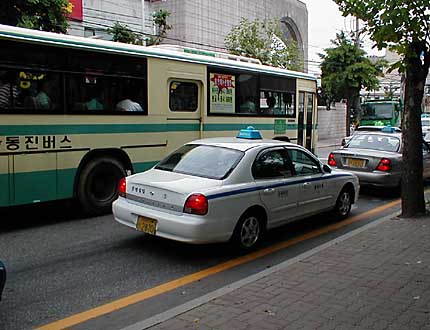
trip now costs 900 - 1200 Won. There are still plenty of riders. Intercity buses are usually faster than the trains, and are surprisingly comfortable. Economy buses make more stops. Seats are catch as catch can and you may even end up standing. Express buses usually make only a rest stop midway and are quieter and smoother. Express bus seats are assigned and they're really comfortable. Most express buses let you eat and drink on board; a few don't. Back in 2000, a Seoul to Kangnung (Gangneung) express bus trip cost 13,000 Won. Nowadays fuel is more expensive and so are bus fares. Today the cheap buses are about 15,000 Won and express buses are around 22,000. In my book this is still one heck of a deal. Warning! In the smaller cities, bus and train stations very often don't have signs in English. If you're traveling alone, you might want to have a Korean friend write down the Hangul characters for both your source and your destination before you go. This lets you match them up with the placards on the buses. If all else fails, show your ticket to the driver. If you're on the wrong bus, he'll usually point you to the right one. (Double check with the driver of that bus!)Taxis: In the States, seeing a taxi is a rare event, unless you're in a big city. Korea, on the other hand, is flat-out overrun with cabs. Seldom do you have to wait more than a few minutes for a ride, at least during daylight hours. They're safe and clean. Even the exhaust is clean, thanks to the LP gas they burn. Fares have gone up since 2000 (what hasn't?), but are still miraculously cheap by world standards. In 2006, meter drop was 1800 Won in Kangnung (Gangneung) and 2200 Won in Seoul. Today (2014) it varies from the low 2000s in small cities to 3000 in Seoul. Each km adds another couple thousand Won or so. Since Kangnung is a smallish place, most trips there still don't cost us much more than 5000 - 7000 Won. Try to find a cab ride for that price in any other first world city! Be prepared for higher rates after midnight though. Koreans don't generally tip cabbies, but they do often round up to the next multiple of 5000 Won. Seoul has "deluxe taxis." These are the black cars with nicer interiors. They supposedly have older, more experienced drivers. We've never noticed much difference, except in the price, which is about double.Don't bother trying to speak English to a Korean cab driver. Very few of them will understand. This is not a big deal, though. All you really need to know is the name of your destination. If you can't pronounce Korean, have a Korean friend write it down and hand the paper to the driver. In Seoul you can supposedly say "Free Translation" to the driver and he'll put you on a mobile phone to a translator. We've never tried this -- never needed to. However, we have had our cabbie ring up the Korean friend we were going to visit, to get directions. Notice what I said above: you need to know the name of your destination. Addresses are for mail. They are of no use at all in a taxi. Cabbies go by landmarks. Unless your destination is pretty well known, you'll need something nearby that is -- a big bank, office building, apartment complex, government building, park, whatever. Hint: your hagwon is most likely not a familiar landmark. The old Best Language Institute was near the Kangnung police station downtown, and all the cabbies knew where that was. Some foreign teachers have reported that big-city cab drivers are reluctant to pick up Western fares because they (the drivers) don't speak English. I have no idea what's up with this, since it's never been a problem for us. One ex-teacher recommends a face-concealing hat for this problem. The practice of hapsung (cabbies picking up additional fares after one is already in the taxi) is supposedly illegal, but you may still run into it. Because of the complexities of fare computation, and some alleged crime risks in the larger cities, it's probably better not to get into a cab if the driver already has a passenger.Korean cab drivers have a reputation for being aggressive drivers. In our experience they're seldom more so than any cabbie in any large city, and no worse at their trade than Korean drivers in general (OK, that isn't saying much). Actually, I've seen Korean bus drivers do more nasty and stupid stuff than cab drivers - tailgating, cutting cars off, and passing on two-lane roads with oncoming traffic. I've heard reports of people being overcharged by taxi drivers. This can probably happen anywhere, especially in countries where you and the driver speak different languages. It hasn't happened to us in Korea, with one exception. Airport transportation: Watch out for scams! If a Korean man approaches you in Incheon airport and asks if you need a cab ride into the city, shake your head vigorously and say NO (pronounced "AHN-nee"). Bogus cabbies will quote you a lowball price in the airport, but when you arrive at your destination it will suddenly develop that you "misunderstood" the driver. Ask me how I know. Drivers without uniforms and without cab markings on their vehicles are NOT licensed cabbies. If you really want to take the risk and ride with one of these drivers, have him write down the quoted price on a piece of paper. Keep that paper in your pocket. Also, rather conspicuously, note down his license tag. That might be enough to make him honest -- or to make him disappear.But why worry? If you're going from Incheon Airport to Seoul, a cab will never be cheaper than the airport bus. Buy a bus ticket at the desk on the first floor of the airport. It'll cost you between 9000 and 15,000 Won, depending on whether it's the economy local or deluxe express bus, and where in Seoul you want to go. Buses run about every 20 minutes and, unlike the train, depart from the airport well into the wee hours. Don't miss your stop! Buses are supposed to have recorded English stop announcements, but we've had trouble hearing them at times. We accidentally got off a stop early once because of this. Since our 2006 visit, Korail have extended the rail lines out to Incheon Airport. Their 4000 Won economy (all stops) train fare to Seoul Station is mighty tempting, especially if the English stop announcements are as clear as they are on the Seoul Metro (subway). Economy trains leave the airport every quarter hour. The train desk is on floor B1 of Incheon Airport. Korail really promote the express trains over economy trains. I don't see the advantage. They take about 10 minutes less to Seoul Station, but leave less often (every half hour), and they cost a lot more. The fare can be anywhere from 7000 to 15,000 Won, depending on what airline you flew in on and other confusing discount factors. Ehh, maybe not. When you figure your cost and travel time, don't forget that either train just gets you to Seoul Station. You still have to get from Seoul Station to your neighborhood via Metro or bus. Seoul Metro (subway) and buses: The base price for a ride is 1150 won -- about US$1 -- for 10km. If you're going farther than 10km, you pay extra. The formula is a little complex and depends on the total distance you're going, but at worst it's another 100 won for each extra 5km. We remember the Metro station ticket windows with humans from the old days, even if they usually had little or no English. The old days are gone, but at least the modern computerized ticket kiosks have English instructions. They're pretty easy to use. A few allegedly take credit cards, but you'll need cash in Won for most. In addition to the ticket itself, you have to put down a 500 Won deposit. You get it back at your end station, if you remember to feed the ticket to the deposit refund machines. We tended to forget. Handicapped access: I'm no expert on this, but it appears to me that Korea has improved significantly since 2000. Back then even Seoul was mostly missing such basics as curb cuts. We're talking about public transportation here, but I think it's worth mentioning a basic accessibility problem in Korea. It's more like Europe than the US -- vertical. Not much is on the ground floor. A sign with the place's name and 2F or 3F means "up the stairs." Newer buildings have elevators, but some hotels, attractions, restaurants, cafes, and so on just aren't available to the wheelchair user without a struggle. As for buses, as I write this in 2015, Seoul claim that half their buses are fitted with wheelchair ramps. The accessible doors are the ones in the middle of the bus's side. I don't know the accessible percentage in other cities. I saw some in Gangneung, but I'll bet you'll have to wait for the next bus (or the next) fairly often. Also, the drivers aren't always too careful about pulling right up to the curb. Once on board, you should find at least one chair locking spot. You may have to lift a regular seat to get to it. Taxies: not such good news. Sedans have LP gas tanks taking up half their trunks, so a chair won't fit. This is why most taxis will pass you up on the street: it's practical, not personal. What you want is a van taxi. Most cities have a few, and Seoul claims a few hundred, but that's a pretty small percentage of the cab population. You're not too likely to catch one on the street. You'll probably need a Korean-speaking friend who can call for one, ideally 24 hours in advance. If you're in Seoul, the Metro (subway) will be a better bet. Trains are almost universally wheelchair accessible. They have locking spots at the ends, where the old folks' seats are. Metro station access varies, though. The transit folks claim that "most stations" have elevators. The ones from the street to ticketing level are big glass boxes, easy to spot. Once you're there, though, you'll find the automated ticket kiosks too tall to be chair-friendly. If you can navigate getting your ticket, you then get to play elevator Where's Waldo. The stations weren't built for elevators, so they've been shoehorned into wherever they fit. If you're lucky, you'll have entered the station from the right street corner and will spot the blue up-down arrow sign. If you're really lucky, the elevator it leads you to will take you to the right tracks. If no, well, at least most Metro workers are willing to help you find the right elevator. As of 2015, some stations still have the old stair lifts. You have to get on the intercom and call for help (English works). In a few minutes an operator or two will show up to work the lift for you. Your ride will be accompanied by a sad little electronic rendition of the old tune There's No Place Like Home. Getting to the actual train platform may entail yet another call, wait, and lift. This may sound tedious and uncomortable, but often you'll actually make better time this way than in searching for a well-hidden self-service elevator. The wheelchair gate will be to the far right or left of the turnstiles. It may swing toward you. If you have mobility problems, Seoul is on a par with many major European cities. Smaller Korean cities, not so much. However, your older Korean friends and those with families are likely to have vans or SUVs, with ample room for chair or scooter. |