|
You don't have to be a Buddhist to appreciate Korea's temples. Besides being handsome buildings, they're
often located on stunning mountain sites. But this isn't just because of the scenery. In the late 14th century,
the Confucians of the
Choson Dynasty
(1392-1910) tried to stamp out
Korean Buddhism.
Today, being in the mountains makes for peaceful meditation. Six hundred years ago, it was more a
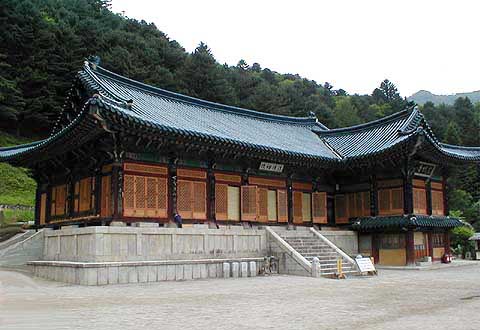
matter of survival. Maybe to the consternation of former Korea president and Seoul mayor Lee Myung-bak, today Korea's constitution now guarantees freedom of religion. Though it's no longer legal to persecute Korean Buddhists, theirs isn't a growing religion. When Margaret was teaching in Korea, 23% of the population were Buddhists. Now it's only 15%. But they haven't lost adherents to Christianity - Catholics and Protestants have also slipped, from about 30% to 28%. A few other religions have small numbers of members, but Korea's biggest and fastest-growing religion is NOTA -- "none of the above" -- 47% back then, 56% today. Buddhism came to Korea from China in 372. Sangwon-sa Temple, in Odaesan National Park in Kangwon Do (Gangwon Province), was begun about 3 centuries later, in 662. Fire has destroyed it several times since then. Each time it's been rebuilt, most recently in 1949. Even for non-Buddhists, temples are worth a visit. Just remember to mind your manners.
|
| Moktak (wood gong) & chanting | [Download] | |
|
The first sound of the day at 3 AM. One monk rises first and walks about the monastery,
beating the moktak and chanting a prayer. He is praying for darkness to give way to light, and
for the suffering of all people to be relieved.
| ||
Medium bell & chanting |
[Download] | |
|
After the monks have had time to wash and dress, this bell is rung in a ritual which
also includes the drum, the gong, and the wooden fish. It calls to those who have
"become decadent."
| ||
Large temple bell |
[Download] | |
|
This temple bell announces the times for chanting. It's rung 28 times in the morning, 36 times at evening,
and 3 times in our recording.
| ||
| If you don't see an audio player on the page above, just click on the download links and use whatever player you have on your computer. |